
Built for Accountability
When software becomes central to your operations, clarity matters. Clear scope. Clear communication. Clear expectations around how work is structured and how decisions are made.
Great software is the result of a clear scope, disciplined process, and aligned execution.
How We Structure Projects
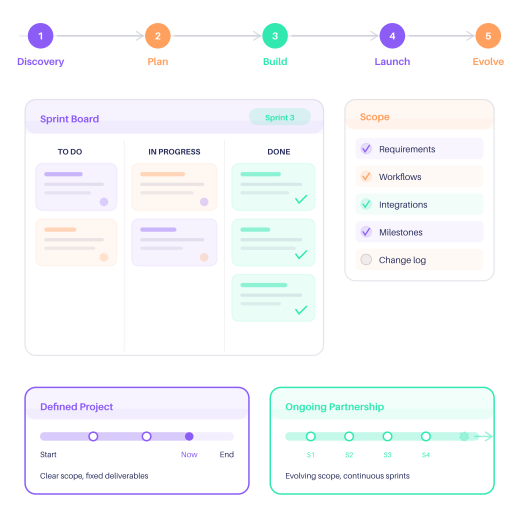
No two organizations are identical, but every successful project begins with clarity. We typically start with a discovery phase to define requirements, workflows, and integration needs before committing to full-scale development.
From there, projects may move into defined development sprints, phased rollouts, and ongoing engineering partnerships — depending on scope and complexity.
Some clients need a clearly defined scope for a single project. Others need a long-term technical partner to help them navigate complex challenges as their systems evolve. We support both.
What remains consistent is transparency in scope, documentation, and change management as your system evolves.
Governance & Security
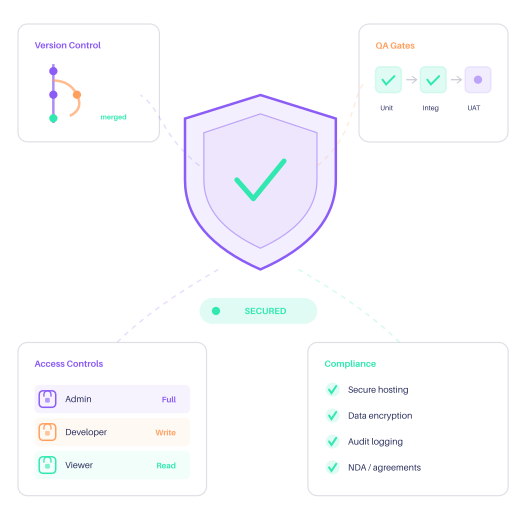
Trust is earned through discipline. Our development process includes structured version control, defined QA checkpoints, role-based access controls, and secure hosting environments appropriate for the sensitivity of your data.
For organizations with compliance or confidentiality requirements, we operate within formal governance standards and execute appropriate agreements as needed.
Security and reliability are not add-ons. They are part of the architecture.
Standards We Build Around
We architect solutions to meet the regulatory and security requirements specific to your industry. Here are the frameworks we commonly work within.
HIPAA governs healthcare privacy and security for protected health information (PHI). If a tool handles patient data for covered entities or business associates, this is the foundational compliance requirement.
We design systems with encrypted data handling, audit logging, role-based access, and BAA-ready infrastructure.
FERPA protects student education records and is critical for K-12, colleges, SIS/LMS tools, edtech, and anything touching official student records.
We ensure proper data segregation, parental consent workflows, and compliant access controls.
GDPR is the heavyweight global privacy law governing how EU personal data is processed and transferred. If you touch data from people in the EU, compliance is mandatory.
We implement data minimization, consent management, right-to-erasure workflows, and cross-border data transfer safeguards.
California's consumer privacy law drives product requirements for many U.S. software companies. Many states now have comprehensive privacy laws, so we often build to a broader state privacy law standard.
We design opt-out mechanisms, data disclosure workflows, and "do not sell" controls that satisfy multi-state requirements.
PCI DSS is one of the most common compliance frameworks in software if you store, process, or transmit payment card data. For many SaaS products, this is one of the most practical compliance burdens.
We architect payment flows to minimize PCI scope, implement tokenization, and ensure secure data handling throughout the transaction lifecycle.
The Gramm-Leach-Bliley Act and FTC Safeguards Rule govern the protection of customer financial information. For financial institutions, this is typically the foundational privacy and security regime.
We build systems with appropriate safeguards for financial data, including encryption at rest and in transit, access logging, and secure data disposal.
SOC 2 and ISO 27001 are not laws, but in B2B SaaS sales they are critical trust signals for security and controls. Customers use them to evaluate vendors before signing contracts.
We help clients architect systems and implement processes that support SOC 2 readiness — covering security, availability, processing integrity, confidentiality, and privacy.
Healthcare Privacy & Security
HIPAA governs healthcare privacy and security for protected health information (PHI). If a tool handles patient data for covered entities or business associates, this is the foundational compliance requirement.
We design systems with encrypted data handling, audit logging, role-based access, and BAA-ready infrastructure.
